
Fire Door Testing Standards: What UK Test Evidence Proves
Updated: 1 hour ago
Summary: Fire door testing standards show how a particular doorset performed under controlled conditions; they do not establish that every installed door will perform the same way. BS 476-22 and BS EN 1634-1 are test methods, while BS 8214:2026 gives practical guidance on specification, installation and maintenance. Check that test evidence matches the door in place, then assess its condition and records.
A fire door is a complete assembly, not just a heavy leaf with a label. The fire door testing standards used for its evidence matter, but so do the frame, seals, hardware, installation and present condition. If you manage premises in Kent or East Sussex, our fire door assessments for your building can help you understand what needs checking on site.
A laboratory test answers a specific question: how did a defined doorset perform in a controlled fire test? It does not show that a different configuration, altered door or poorly maintained installation will perform identically. Knowing that distinction helps you interpret evidence and decide when a competent site assessment is needed.
What does a fire door test establish?
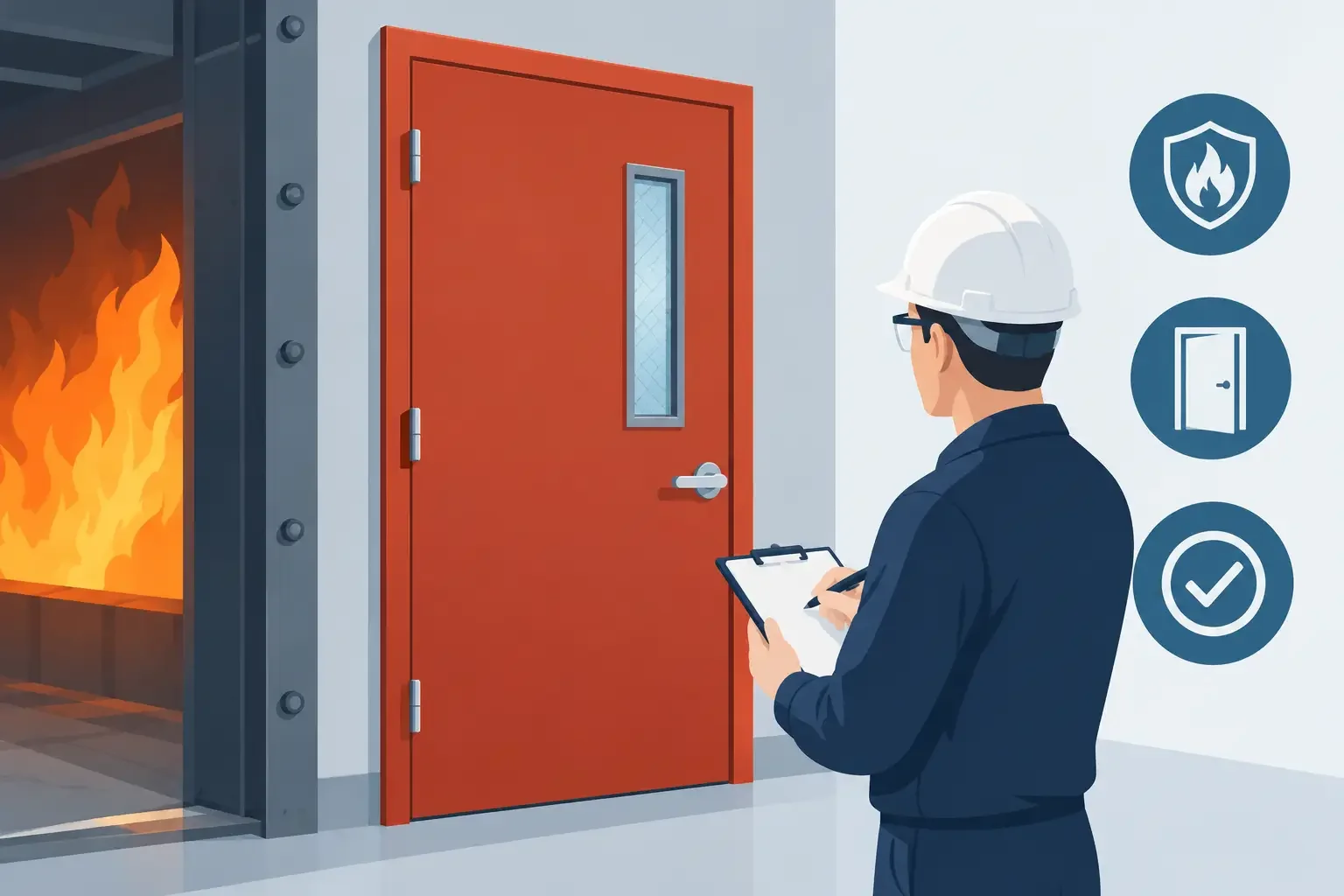
Imagine a doorset undergoing a controlled fire test. The result relates to the specimen and configuration tested, including relevant construction details and components. It provides evidence about performance under those test conditions, not a blanket approval for every door that looks similar.
The assembly may include the door leaf, frame, hinges, latch, closer, seals and any glazing or other openings. A change to an important component or detail can affect whether the original evidence applies. That is why a label alone is not enough to confirm that an installed door matches the tested design.
Test evidence should be read alongside product and installation information. Look for the door’s identity, the tested construction and any documented scope for variations. If those details do not align with the door on site, ask a competent person to assess the gap rather than assuming the evidence covers it.
Which fire door standards appear in UK evidence?
Two test methods commonly encountered in UK fire door records are BS 476 fire doors evidence, particularly BS 476-22, and BS EN 1634-1. The UK Government’s construction standards report lists both among commonly used fire safety standards.
BS 476-22 sets out a method for determining the fire resistance of non-loadbearing construction elements. BS EN 1634-1 specifies a fire resistance test for door and shutter assemblies and openable windows. Each describes a test method; neither tells you, by its name alone, whether a particular installed door meets the building’s requirements.
Do not treat different standards or test documents as automatically interchangeable. Check which method the evidence refers to, what assembly was tested and how the stated result relates to the door’s intended role. The required performance should be considered in the context of the building’s fire strategy and applicable requirements.
What does a successful test not prove?
A test report does not inspect the door currently hanging in your building. It cannot confirm that the same components were fitted, that the installation followed the permitted details or that wear and later alterations have not changed the assembly.
For example, a tested configuration may include a particular closer, glazing arrangement and seal. If a closer is replaced or an opening is altered, you need evidence that the change remains within the product’s permitted scope. The Fire Door Alliance’s testing guidance explains that testing concerns the complete assembly and that certificates define the scope of a product’s use.
Testing and inspection answer different questions. A test establishes how a defined specimen performed under test conditions; an inspection considers the door and its condition in its actual setting. Neither should be mistaken for the other.
The door’s purpose matters too. A door protecting an escape route or separating areas may have a specific role in the fire strategy. Use relevant BS 9999 fire safety guidance as context, while checking the requirements that apply to your building and its design.
Why does BS 8214 matter in 2026?
On 20 March 2026, BSI published BS 8214:2026, which supersedes BS 8214:2016. BSI describes the current standard as a code of practice for fire-resisting and smoke control doors. It covers practical considerations for specification, design and performance in use.
Unlike BS 476-22 and BS EN 1634-1, BS 8214 is not itself a fire resistance test method. It provides practical guidance on doors designed and tested under those methods, alongside relevant smoke-control methods. The BSI standard information identifies its scope, including timber, metal and composite fire doors.
If you are reviewing older records, note the edition cited and the date it applied to the work. A newer code of practice does not, by itself, tell you whether older test evidence remains suitable for an existing door. Compare the evidence with the installed assembly and the building’s current requirements.
When should inspection and maintenance take over?
In an occupied building, everyday use can loosen hardware, damage seals or affect how a door closes and latches. Repairs, decoration and new access-control equipment can also alter a doorset. Routine checks help identify visible problems; a more detailed assessment is appropriate when evidence is unclear or a defect needs technical evaluation.
Inspection frequency should reflect the premises, the door’s use and applicable duties. For practical planning, see how often fire doors should be checked. Keep a record of findings, repairs and follow-up checks so that you can see whether defects were addressed.
Look for whether the door closes and latches, whether seals appear intact, and whether the frame, hinges and hardware show damage or looseness. These checks do not replace a competent assessment where the door’s performance, specification or repair needs remain uncertain.
What evidence should you keep with each door?
A useful record connects the test evidence to the door that was actually installed. Start with the door’s location and identifying details, then retain the available test report, classification or certification documents and installation information.
Also record alterations, repairs and inspection findings. If the door’s identity or history is uncertain, document that uncertainty and the next action needed. To confirm which openings in your premises need attention, our article on what counts as a fire door in your building can help clarify what to look for.
Our fire safety consultants hold relevant certifications and training. A fire door assessment from our team checks doors’ compliance and functionality, helping you identify issues that need follow-up without confusing an on-site assessment with laboratory testing.
Use test evidence in context
Fire door testing standards establish how a defined assembly performed under specified test conditions. To apply that evidence responsibly, check that it relates to the door in place, consider the door’s role in the building, and keep inspection and repair records current. For premises in Dover, Ashford, Maidstone, Tunbridge Wells, Eastbourne, Hastings, Brighton, Crawley, Worthing, Canterbury, Dartford, Kent, East Sussex and West Sussex, the same principle applies: connect the test evidence to the installed door and its ongoing condition.
Discuss fire door assessments for your premises
If your records do not clearly match the doors on site, or you have concerns about their condition, a focused assessment can help you understand what needs attention. The appropriate next step depends on the door’s role, condition and available evidence.

We provide on-site fire door assessments that check compliance and functionality, with findings tailored to your premises and requirements. Our consultants hold relevant certifications and training, and guide you through the assessment process. To discuss your needs across Kent, East Sussex or West Sussex, explore our fire door assessment services or contact our team directly.
Frequently Asked Questions
What is the difference between BS 476-22 and BS EN 1634-1?
They are separate fire resistance test methods, with BS 476-22 addressing non-loadbearing construction elements and BS EN 1634-1 addressing door and shutter assemblies and openable windows. Check the specific test evidence and its scope rather than relying on the standard number alone.
Does a fire door test certificate prove my installed door is compliant?
Not by itself. Confirm that the evidence relates to the installed doorset and its components, then check the door’s condition and suitability for its location.
Is BS 8214 a fire door testing standard?
No. BS 8214:2026 is a code of practice for fire-resisting and smoke control doors, including practical considerations for specification, design and performance in use. BS 476-22 and BS EN 1634-1 are test methods.
Can an existing fire door be assessed if its test records are missing?
Yes, an on-site assessment can check observable condition, compliance and functionality. Missing records do not establish that a door is unsuitable, but they can mean further investigation is needed.
What can a Kent and Sussex FRA fire door assessment cover?
Our fire door assessments check doors’ compliance and functionality. They are on-site assessments, not laboratory fire testing or certification against a particular standard.


Comments