
Fire Door Assessments: A Practical Guide to Checks and Action
Updated: 55 minutes ago
Summary: Fire door assessments examine the installed door, frame, hardware, seals and closing performance, then record defects and next steps. The right scope depends on the building and the door’s role. A clear door register and repair log help you track findings and verify completed work.
Fire door assessments are not just a glance at the door leaf: the full opening must perform as intended. A door that looks sound can still have problems with its frame, seals, hardware or closing action. For organisations across Kent, East Sussex and West Sussex, including Dover, Ashford and Canterbury, planned checks should suit the premises. Our page on fire door inspection frequency explains how inspection intervals fit into ongoing maintenance.
A useful assessment records what was examined, what needs attention and what action is recommended. It is distinct from routine staff observations and product fire testing. The scope should reflect the building’s use, fire safety arrangements and available records, so the report answers the questions you need resolved.
What does a fire door assessment examine?
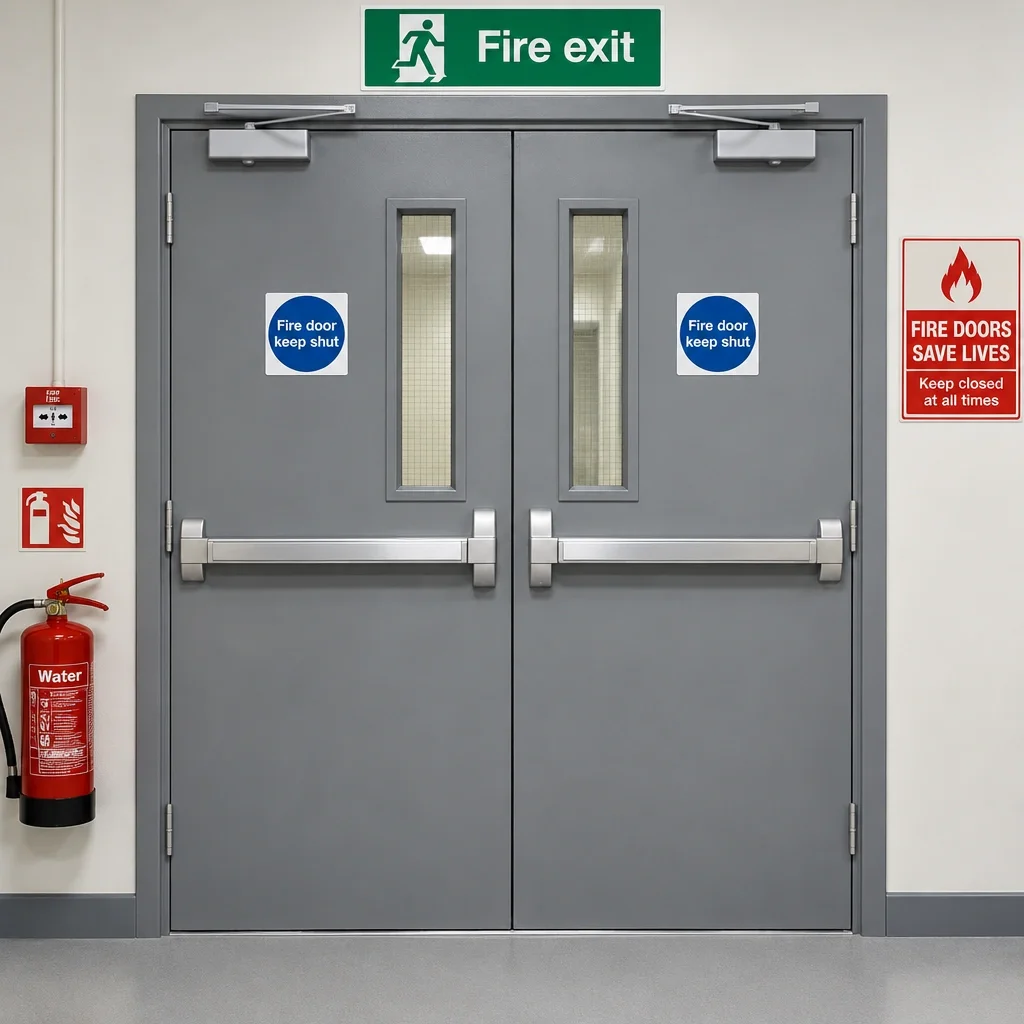
A fire door assessment reviews the installed door as a functioning assembly. This includes the door leaf and frame, glazing where present, seals where specified, hardware and self-closing operation. The assessor should consider each opening’s role, not just whether the door appears undamaged. Understanding the purpose of fire doors in different locations helps frame that review.
Checks should cover whether the door closes and latches properly, whether paired doors close in the correct sequence where relevant, and whether visible damage or alterations need attention. The report should identify the opening and describe any defects clearly enough for you to locate them and arrange follow-up.
Keep an installed-door assessment distinct from product fire testing. A site assessment examines an existing opening; it does not mean that the door has been laboratory tested or newly certified. Our explanation of fire door testing standards covers what testing can establish. Government guidance also distinguishes simple routine checks from periodic specialist assessment of whether doors remain adequate for the fire risk.
What belongs on a practical fire door assessment checklist?
A closer that does not pull the door shut is a clear reason to look beyond the door’s appearance. Use a fire door assessment checklist to organise observations and records, while leaving technical judgements to the agreed assessment scope.
Door and frame: Record visible damage, distortion, holes, glazing condition and any identification that is present.
Seals and clearances: Note the condition of seals where specified. Record where any gap was checked and the criterion used, rather than assuming one measurement applies to every door.
Hardware and operation: Check the closer, hinges, latch and other fitted hardware. Record whether the door closes fully and latches, and whether paired leaves operate in the required sequence.
Location and history: Link the opening to its floor or room, and note known repairs, alterations or missing records.
A door register gives each opening a unique identifier and location, making it easier to connect a finding to the correct door. If you are establishing which openings should be listed, our page on identifying fire doors in your building offers a useful starting point.
Which legal checks apply to your building?
The required schedule depends on the building and the rules that apply to it. In England, Regulation 10 of the Fire Safety (England) Regulations 2022 sets specific checks for certain multi-occupied residential buildings with a top storey more than 11 metres above ground level. The Regulation 10 text requires checks of communal fire doors at least every three months and best endeavours to check flat entrance doors at least every 12 months.
Those intervals apply to the buildings and doors covered by the regulations, not as a universal timetable for every premises. The required routine checks also serve a different purpose from a specialist assessment. Check your building’s fire risk assessment and applicable duties before setting a programme, particularly if your premises are outside England.
How do you turn findings into completed repairs?
A finding only becomes useful when it leads to an action and a recorded outcome. Give each issue an owner, an agreed next step and a way to verify the work. Keep the original observation alongside the repair record, so you can see what changed and whether the concern was resolved.
Record the door identifier, location, observed defect and any supporting photograph.
Ask a competent person to clarify the recommended action and any interim measures needed.
Assign responsibility and agree a completion date suited to the finding and your circumstances.
After the work, record the completion date and verify the relevant operation before closing the item.
A March 2026 report published by the FIA, drawing on responses from 88% of English local authorities, found that 46% of flat entrance doors and 89% of communal fire doors in its social housing review had been inspected at least once since January 2023. This is a social housing snapshot, not a measure of every building. The FIA’s 2026 report underlines the value of tracking which doors have been checked and what remains outstanding.
For a portfolio spanning Maidstone, Tunbridge Wells, Eastbourne, Hastings, Brighton, Crawley, Worthing and Dartford, a consistent register makes it easier to see which doors have been assessed, which were inaccessible and which repairs remain open. Keep inaccessible doors visible as outstanding items rather than marking them complete.
What should you expect from the assessment report?
A clear report identifies the doors included, the assessment basis, findings, limitations and recommended next steps. Check that it distinguishes a confirmed defect from missing evidence or a door that could not be accessed. This gives your team a practical record for arranging work and checking progress.
Before booking, ask who will conduct the on-site assessment, how findings will be explained and what information you should prepare. Our consultants hold relevant certifications and training, and we tailor consultations to your organisation’s requirements. We arrange bookings personally and follow up to confirm the details, so you can discuss access arrangements and the scope before the visit.
Make fire door checks part of routine management
A well-scoped fire door assessment connects each opening to its role, records defects clearly and gives you a way to follow through on repairs. Keep a current door register, confirm the checks that apply to your premises and verify completed work. If you manage a property across Kent, East Sussex or West Sussex, use the same clear process to track findings from assessment through close-out.
Discuss a Fire Door Assessment
When you know which doors need attention, the next step is to agree an assessment scope that suits your premises. We carry out on-site fire door assessments for organisations across Kent, East Sussex and West Sussex, checking door compliance and functionality. Our consultations are tailored to your requirements.

Our consultants hold relevant certifications and training, and we handle booking requests personally before following up to confirm details. To discuss your site, share the building type, approximate number of doors and any access restrictions. Explore our fire door assessment services or call 01825 598760 or 07916 160080.
Frequently Asked Questions
How is a fire door assessment different from a routine check?
A routine check helps identify obvious problems during ongoing building management. An assessment provides a structured review of the installed doors and records findings for follow-up.
Does every premises need the same inspection schedule?
No. The appropriate schedule depends on the building, its use and the duties that apply. Check your fire risk assessment and relevant regulations before setting intervals.
What should I prepare before an assessment?
Prepare a door register, previous reports, available installation or repair records, and details of known alterations. Arrange access to all relevant areas and flag any doors that may be difficult to reach.
What should happen after a defect is recorded?
Assign the finding to a responsible person and agree the next action with competent advice where needed. Record the repair and verify the relevant door operation before closing the item.
Can Kent and Sussex FRA assess doors at our premises?
Yes. We provide on-site fire door assessments tailored to your organisation’s requirements across Kent, East Sussex and West Sussex. We handle booking requests personally and follow up to confirm details.


Comments